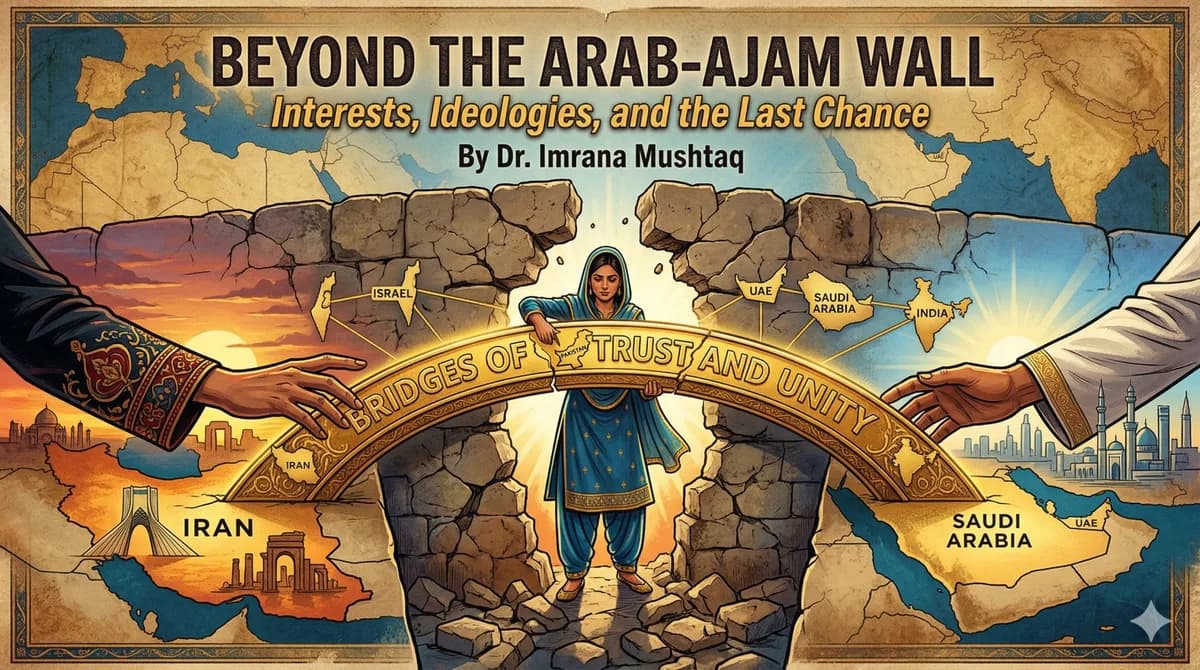
Sometimes in global politics, moments arrive when the curtains are drawn back, and reality stands exposed in all its bitterness. In recent years, Middle Eastern politics has taken a similar turn where the hidden layers between relationships, interests, and ideologies are being unveiled. The business ties of the Gulf states, especially the ruling elite of the UAE, their relations with Israel, and their growing partnership with India have sparked a new debate. This debate is not limited to diplomatic relations but has challenged the intellectual, religious, and political framework of the entire Muslim world.
It is no longer a secret that in global politics, there is no concept of permanent enmity or permanent friendship; rather, interests are the true axis. This is why the UAE, while normalizing relations with Israel on one hand, has also expanded its economic and defense ties with India to an extraordinary extent. These relations have created a new balance in the region, but at the same time, raised several questions. Are these relations merely the result of economic interests, or is there a grand strategic mindset behind them?
Here, another important aspect comes to the fore: the long-standing tension between Iran and the Arab world. Iran presents itself as a revolutionary state that wants to present not only its ideologies but also its political model to the world. On the other hand, the Arab world, especially Saudi Arabia, represents a different religious and political structure where the monarchy is viewed as a stable system.
The issue is not which system is better, but the real problem is that each side has been trying to impose its system on the others. Whether it is the export of revolutionary ideologies from Iran or the promotion of Sunni or Wahhabi thought from the Arab world, both have deepened the divide within the Muslim world. This division is not only ideological but has practically destabilized many countries.
Today, as the UAE's relations with Israel and India are coming out into the open, it serves as both an opportunity and a warning. An opportunity for the Muslim world to look inward and see where the real threat lies. Is the threat truly from each other's ideologies, or is it the political and economic weakness that has given foreign powers the opportunity to interfere within us?
For Iran, this is a moment for particular reflection. If Arab countries wish to maintain their political system, namely the monarchy, it is an internal matter for their people. No external power should have the right to interfere in it. Similarly, the Arab world must also understand that attempting to spread a specific sect or religious thought to other countries is not only unnecessary but also harmful.
The Arab-Ajam divide, which is centuries old, still dominates our minds today. This division is not merely linguistic or ethnic; it has taken the shape of a mental wall. This wall has distanced us from one another, and global powers are taking advantage of this very distance.
It is also an established fact that most of the problems of the Muslim world are internal. Sectarianism, political instability, economic weakness, and educational backwardness are the factors that have weakened us. Until we find a solution to these problems, external powers will continue to interfere in our affairs.
Pakistan's role in this entire situation is extremely important. Pakistan has adopted a balanced and cautious policy in the recent tensions, which is not only a manifestation of its diplomatic foresight but also a requirement of its internal needs. At a time when the world is clearly dividing into two blocs, Pakistan's neutrality is a wise decision.
This neutrality is not a weakness but a strategy. Pakistan knows very well that standing with one party could mean losing the other, and the entire region might have to suffer the consequences.
Today, there is a need for the Muslim world to redefine its priorities. We must decide whether we will continue to use our resources against each other or utilize them for the betterment of our people.
It is time for Iran and the Arab world to respect each other's political and religious systems. Iran must accept that the monarchy in Arab countries is a reality, and trying to change it is not only unnecessary but also impractical. Similarly, the Arab world must understand that Iran has its own ideological and political structure that cannot be forcibly changed.
If we waste this opportunity, the consequences could be horrific. Our future generations will never forgive us for exacerbating our differences instead of resolving them.
Stepping out of this Arab-Ajam divide is the greatest need of the hour. We need a new mindset, a new vision, and a new strategy that can lead us toward a strong and united Muslim world.
This is the moment when we must decide whether we want to become a part of history or remain crushed beneath its weight. If we still do not set our priorities right, this might be our last chance.
Pakistan's neutrality is a sign that there is still hope. But this hope can only become reality when we all understand our responsibilities and act upon them.
It is time that we tear down the walls of hatred and build bridges of trust. This is the only path that can lead us toward progress, stability, and peace.