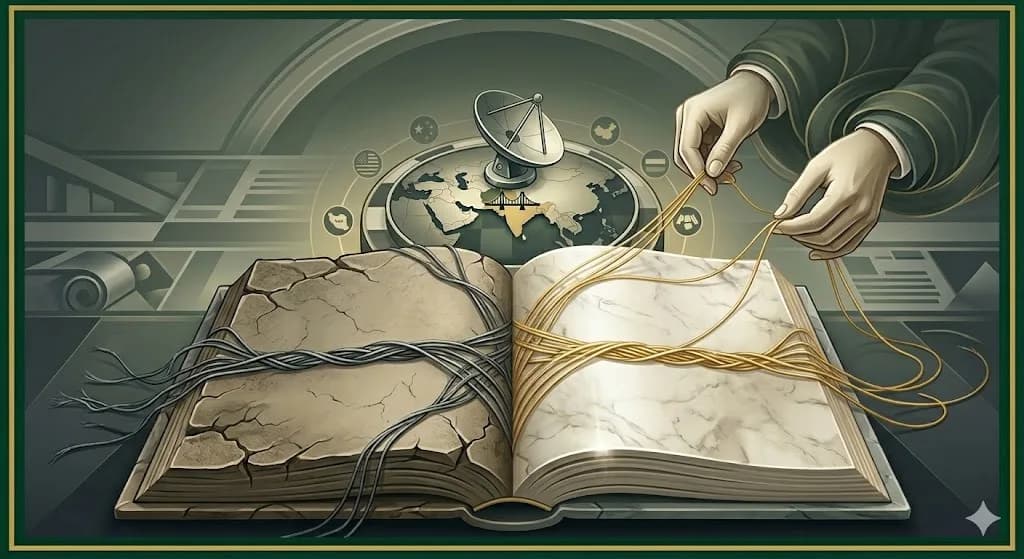
In international politics, there are sometimes turning points where reality and perception become intertwined. In such moments, true success is achieved not just on the battlefield but in the narrative. What is currently being said and written about Pakistan in the global scenario is not merely an incident but the formation of a narrative. The question is not how the "miracle" happened, but rather whether it was truly a miracle or the result of a long, silent, and continuous strategy?
In global politics, states are driven by interests, not emotions. Pakistan is no exception to this rule. After being trapped in a narrative of terrorism, instability, and internal crises for years, if Pakistan is seen today as a potential mediator, a responsible state, or a diplomatic player, this change did not happen overnight. It is deeply influenced by developments at multiple levels, regional compulsions, and the needs of global powers.
The real truth is that the current global order is in search of a new balance. The US, China, Russia, and regional powers are all trying to secure their respective spheres of influence. In this context, countries that can play the role of a "bridge"—geographically, ideologically, or strategically—suddenly become important. Pakistan's geographical position, placing it at the crossroads of South Asia, the Middle East, and Central Asia, is once again working in its favor.
It is also a fact that the tension between Iran and the Arab world, the rivalry between the US and China, and the changing dynamics of the Middle East have created a vacuum. Filling this vacuum required a country that could communicate with multiple parties simultaneously. A unique aspect of Pakistan is that it is neither completely tied to one bloc nor entirely isolated. This very "middle ground" became its greatest strength.
However, attributing this entire story to a single personality or institution is tantamount to escaping reality. State policy is always collective. It involves military leadership, diplomatic circles, the political government, and international circumstances. If some circles declare it the marvel of "Munir & Company," it is a simplistic narrative, whereas the actual picture is far more complex and layered.
The role of international media is also noteworthy here. When positive news about a country emerges, it is not mere praise but a message. This message is sometimes directed at other countries and sometimes at the country itself, indicating the direction it is heading. Recent praises for Pakistan should be viewed in this context. It is both an opportunity and a test.
India's reaction also helps in understanding this entire situation. On one hand, there is criticism and sarcasm, and on the other, acknowledgment and realism. This division actually reflects that South Asian politics is entering a new phase. Now, merely a display of power is not enough; diplomatic skill, narrative building, and global acceptance have become equally important.
Another aspect cannot be ignored here. Pakistan's internal situation—economic pressure, energy crises, sectarian sensitivities—also compels it to play a role in reducing regional tensions. Therefore, if Pakistan appears active in any mediation, it is not just for global prestige but for its own internal survival. This is where principles and interests intersect.
The real question is whether this temporary success can transform into a permanent policy. History shows that Pakistan has seized important opportunities in the past but failed to convert them into lasting advantages. The danger this time as well is that if this diplomatic success is not coupled with institutional policy, economic stability, and internal harmony, it will remain merely a momentary flash.
Another crucial point is that the real benefit of improving one's global image is realized only when it reaches the masses. If there is praise on the global stage while the public domestically suffers from inflation, unemployment, and insecurity, this contradiction cannot be sustained for long. A state's true success is one that brings improvement to the lives of its citizens.
After all this discussion, it is more appropriate to say that this is not a "miracle" but a combination of circumstances, strategy, and opportunism. Pakistan recognized an opportunity and capitalized on it. The real test now is whether it can turn this opportunity into a permanent path.
In global politics, no success is final. Those who praise today may criticize tomorrow. Therefore, instead of being swayed by temporary accolades, there is a need to adopt a long-term vision—a vision that ensures stability, progress, and harmony not only on a global level but also nationally.
Ultimately, states survive on performance, not narratives. If Pakistan succeeds in turning this moment into a new beginning, that will be its true victory. Otherwise, history is full of such "miracles" that, over time, fade into mere news items.